


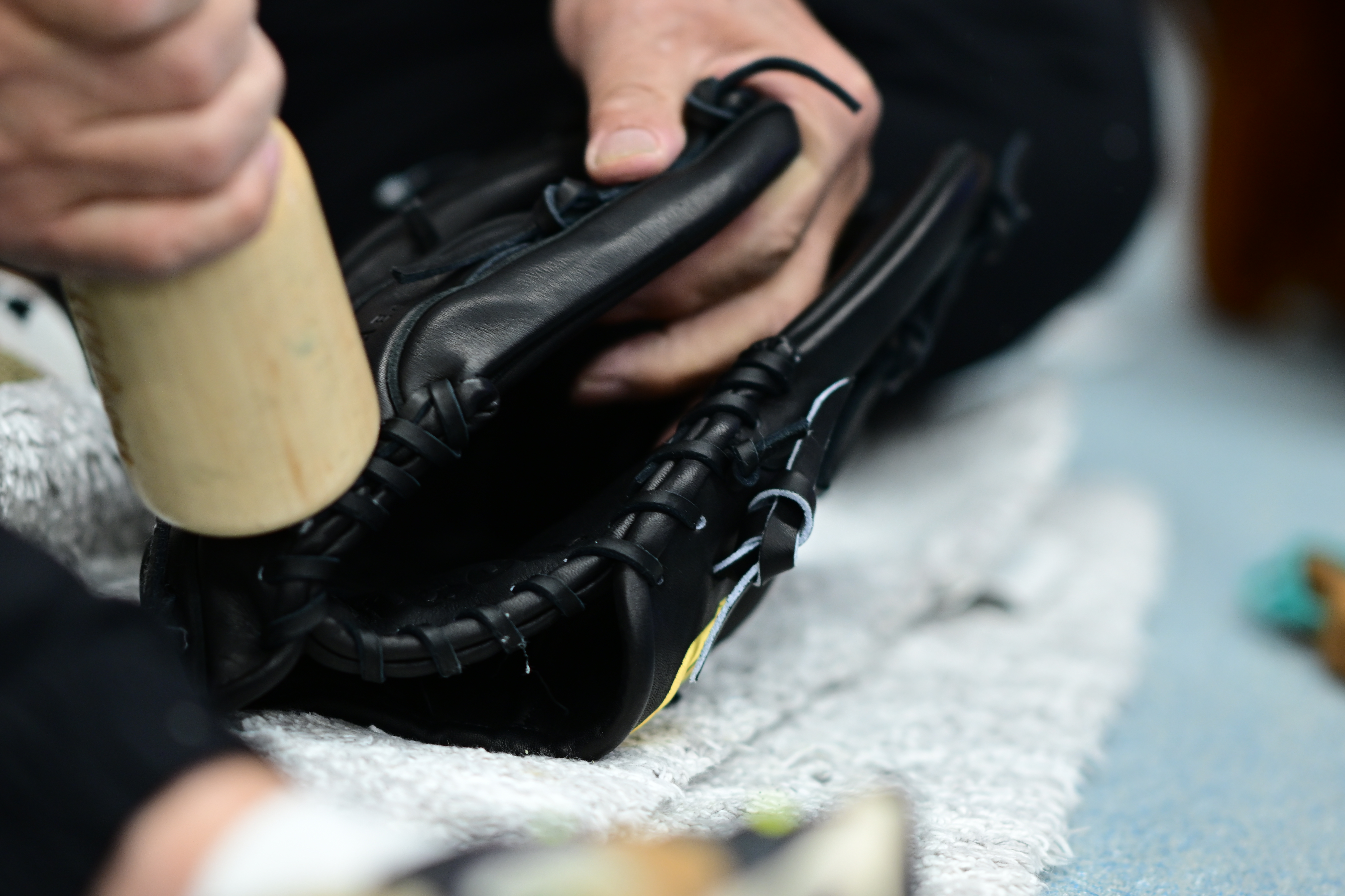
1. Why Do Baseball & Softball Gloves Need to Be Broken In?
Higher-quality baseball and softball gloves are made from stronger, more structured leather.
When new, the glove may feel:
- stiff
- difficult to close
- flat through the pocket
- tight around the hand
- resistant around the hinge points
As the glove is used, the leather gradually becomes more flexible in the areas where movement is needed.
At the same time, the pocket begins to form around the ball.
The result is a glove that feels more natural, closes more easily and fits the player's hand better.
2. How Long Does It Take to Break In a Glove?
There is no exact break-in time.
It depends heavily on the glove's leather, construction and initial stiffness.
Youth & Entry-Level Gloves
Many youth and beginner gloves use softer leather or synthetic materials.
They may be nearly game-ready straight from the store and require very little break-in.
Mid-Level Leather Gloves
These typically require some regular use before they feel completely comfortable.
Playing catch several times may be enough to noticeably soften the glove and begin forming the pocket.
Premium Leather Gloves
High-quality gloves made from premium steerhide, Pro Stock leather, kip leather or similar materials generally require more time and effort.
This is normal and shouldn't be considered a disadvantage.
The additional structure is one of the reasons premium gloves can maintain their shape for many seasons.
Don't try to turn a premium glove into a completely soft glove overnight.
3. The Best Way to Break In a Baseball or Softball Glove
The safest and most effective method is also the simplest:
Play Catch.
Repeatedly catching a ball naturally works the leather exactly where it needs to move.
It helps:
- form the pocket
- flex the hinge points
- shape the fingers
- loosen the glove gradually
- adapt the glove to your hand
Whenever possible, use the same type of ball you normally play with.
Baseball glove → use a baseball
Fastpitch softball glove → use a softball
This is particularly important because a softball requires a larger, deeper pocket than a baseball.
4. Step 1 – Put the Glove On and Learn How It Wants to Close
Before aggressively working the glove, put it on your hand and close it several times.
Pay attention to the natural hinge points.
Different glove patterns are designed to close differently.
Some naturally close more thumb-to-pinky, while others close more toward the middle fingers.
Don't force every glove into exactly the same shape.
The pattern, position and player's preference should influence how the glove develops.
5. Step 2 – Work the Hinge Points
The hinge areas near the heel of the glove are responsible for much of the closing action.
Gently flex these areas back and forth with your hands.
You can also close the glove repeatedly while applying moderate pressure around the hinges.
The goal is to make the glove easier to close without making the entire glove unnecessarily soft.
Important:
Try to keep the fingers and thumb relatively structured.
A properly broken-in glove should be flexible where it needs to move and structured where it needs support.
6. Step 3 – Start Forming the Pocket
Place a baseball or softball in the area where you want the pocket to develop.
Close the glove around the ball and apply pressure with your hands.
Repeat this several times.
You can also throw the ball firmly into the pocket by hand.
The goal is to gradually create a defined catching area rather than flattening the entire glove.
7. Step 4 – Use a Glove Mallet
A glove mallet can significantly speed up the break-in process without exposing the leather to excessive heat or moisture.
A mallet simulates repeated catches.
Put the glove on your hand and strike the pocket repeatedly with the rounded end of the mallet.
Focus primarily on:
- the pocket
- hinge points
- areas where the ball naturally lands
You can also place the glove on a stable surface and work the pocket from different angles.
Don't hit everything equally.
The objective isn't to soften the entire glove.
You want to develop the pocket and flexibility while maintaining structure in the fingers, thumb and outer edges.
8. Step 5 – Play More Catch
After working the pocket and hinges, go back to playing catch.
This is where the glove really begins to adapt to the player.
Try to catch the ball naturally in the pocket rather than intentionally squeezing the glove into an unnatural shape.
Over time, the combination of repeated catches, hand pressure and normal movement will create a glove that feels increasingly natural.
9. How to Shape the Pocket
Not every player wants the same pocket.
Position plays an important role.
Infield Gloves
Infielders often prefer a relatively shallow pocket.
This makes it easier to get the ball out of the glove quickly when making fast throws or turning double plays.
Avoid creating an unnecessarily deep pocket in a middle-infield glove.
Outfield Gloves
Outfielders generally benefit from a deeper pocket that helps secure fly balls.
Larger gloves such as 12.5" and 12.75" naturally provide more space to develop a deeper pocket.
Pitcher's Gloves
Pitchers generally want a secure pocket that allows them to comfortably hide the ball and grip.
First Base Mitts
First base mitts benefit from a deep, secure pocket designed to receive throws.
Catcher's Mitts
Catcher's mitts require a particularly well-defined pocket.
Because of their heavy construction and padding, premium catcher's mitts can require significantly more break-in than standard fielding gloves.
10. Breaking In a Fastpitch Softball Glove
The basic process is the same as for a baseball glove, but there is one important difference:
Use a softball to form the pocket.
A fastpitch softball is significantly larger than a baseball.
Using a softball during break-in helps develop the deeper, wider pocket required to secure the larger ball.
This is particularly important for:
- fastpitch outfield gloves
- first base mitts
- catcher's mitts
Playing catch with an actual softball is one of the best ways to naturally shape the glove for the sport.
11. Breaking In a Catcher's Mitt
Catcher's mitts deserve special attention because they can be among the stiffest gloves when new.
Start by working the hinge points and gradually forming the pocket.
A glove mallet is particularly useful here because it allows you to simulate hundreds of catches without having someone throw hundreds of pitches.
Once the mitt begins to close more comfortably, catching actual pitches will continue shaping the pocket.
For fastpitch catcher's mitts, always use a softball when forming the final pocket.
Don't rush a premium catcher's mitt.
It may require considerably more work than a standard fielding glove.
12. Should You Use Glove Conditioner?
Glove conditioner can be useful, but more isn't better.
A small amount of a suitable baseball glove conditioner can help maintain leather and, depending on the product, make it slightly easier to work.
However, excessive conditioner can:
- make the glove unnecessarily heavy
- oversoften the leather
- darken some leathers
- affect the glove's structure
- leave residue
Always follow the instructions for the specific conditioner and check the glove manufacturer's care recommendations.
Conditioner isn't a substitute for break-in.
The glove should primarily be broken in through movement, pocket work and catching balls.
→ SHOP GLOVE CARE PRODUCTS
13. Should You Use Glove Oil?
Be cautious with glove oils.
Some oils can penetrate leather deeply and may significantly darken or soften it.
Using too much can also add unnecessary weight.
If you decide to use any leather-care product, choose one specifically suitable for baseball or softball gloves and apply it sparingly.
For premium gloves, always check the manufacturer's recommendations first.
14. Should You Put a Ball in Your Glove When You're Not Using It?
You can place a baseball or softball in the pocket when storing the glove, particularly during the early stages of break-in.
This can help maintain the pocket shape.
However, don't tightly wrap or compress the glove for long periods in a way that forces it into an unnatural shape.
The goal is to maintain the pocket – not flatten the glove around a ball.
A glove case can also help protect the glove from being crushed inside an equipment bag.
→ SHOP GLOVE CASES & ACCESSORIES
15. What NOT to Do When Breaking In a Glove
This is just as important as knowing what to do.
Avoid extreme methods designed to make a glove game-ready as quickly as possible.
Don't Put Your Glove in the Oven
Heat can dry out leather, affect adhesives and damage components of the glove.
Don't Microwave Your Glove
Never microwave a baseball or softball glove.
Besides potentially damaging the leather and internal components, gloves may contain metal parts.
Don't Soak the Glove in Water
Leather and excessive water aren't a good combination.
Soaking can affect the leather's structure, cause uneven drying and shorten the glove's lifespan.
Don't Use Boiling Water
Some break-in techniques recommend pouring very hot or boiling water over the glove.
We don't recommend this approach for your new glove, particularly with premium leather.
Don't Drive Over It
Yes, this is an old baseball myth.
Driving over a glove may make it flatter. That's not the same thing as properly breaking it in.
Don't Leave It in a Hot Car
High temperatures can dry out leather and negatively affect its condition.
Don't Use Excessive Oil or Conditioner
More product doesn't mean faster or better break-in.
Too much can oversoften the glove and add unnecessary weight.
16. Soft Is Not the Same as Broken In
This is one of the most important things to understand.
A properly broken-in glove shouldn't necessarily be extremely soft.
The ideal glove has:
a formed pocket + flexible hinges + structured fingers and thumb.
If the entire glove becomes floppy, it can lose some of the structure that helps it perform properly.
This is particularly important with premium gloves.
Players invest in high-quality leather partly because it provides structure and maintains its shape over time.
The goal is control – not maximum softness.
17. Should You Flare the Thumb and Pinky?
Some players like to slightly flare the thumb and pinky outward.
This can create a wider catching surface and influence how the glove funnels the ball into the pocket.
It is particularly common with some infield and outfield glove setups.
Other players prefer a more traditional shape.
Neither approach is universally correct.
The best shape depends on:
- position
- glove pattern
- closure preference
- pocket preference
- individual playing style
Shape the glove around how you actually use it.
18. Should You Store Your Glove Closed or Open?
Avoid crushing the glove completely flat.
A good approach is to store it with the pocket naturally formed.
You can place a ball in the pocket and close the glove gently around it.
For premium gloves, a protective glove case can help prevent other equipment from flattening or deforming the glove inside your bag.
Keep the glove in a dry, ventilated environment away from excessive heat and moisture.
19. What If Your Glove Gets Wet?
Baseball and softball are outdoor sports, so sometimes your glove will get wet.
If that happens:
- Gently remove excess moisture with a clean towel.
- Allow the glove to air dry naturally.
- Keep it away from radiators, hair dryers and other direct heat sources.
- Once completely dry, check the condition of the leather.
- If appropriate, apply a small amount of suitable glove conditioner.
Don't try to speed up drying with high heat.
Slow, natural drying is safer for the leather.
20. How Do You Know When Your Glove Is Game Ready?
A glove is ready when you can comfortably:
- open and close it
- control it with one hand
- catch the ball consistently
- keep the ball securely in the pocket
- remove the ball when needed
- maintain the desired glove shape
The glove should feel natural without being excessively soft or floppy.
For competitive play, test the glove during several training sessions before using it in an important game.
Quick Glove Break-In Guide
If you want the simple version:
1. Put the glove on and identify its natural closure.
2. Gently work the hinge points.
3. Form the pocket using the correct ball.
4. Use a glove mallet to work the pocket.
5. Play catch – a lot.
6. Use conditioner only when appropriate and sparingly.
7. Store the glove without crushing its shape.
8. Give premium leather time to break in naturally.
And most importantly:
Don't try to make your glove completely soft.
Break it in. Don't break it down.
Frequently Asked Questions About Breaking In a Glove
What is the fastest way to break in a baseball glove?
Playing catch combined with manually working the hinge points and using a glove mallet is one of the safest ways to speed up the process.
It works the areas that actually need to become flexible without unnecessarily exposing the leather to extreme heat or moisture.
How long does it take to break in a baseball glove?
It depends on the glove.
Soft youth gloves may require almost no break-in, while premium leather gloves and catcher's mitts can require considerably more time and repeated use.
Can I break in a baseball glove overnight?
You can begin forming the pocket and making the hinges more flexible, but a high-quality leather glove shouldn't need to become completely game-ready overnight.
Allowing the glove to gradually form around your hand generally produces a better result.
Should I use oil to break in my glove?
Oil isn't necessary for breaking in most gloves.
If you use a leather-care product, apply it sparingly and make sure it's suitable for your glove.
Can I use Vaseline on a baseball glove?
We recommend using products specifically designed or approved for baseball glove or leather care rather than household products.
This gives you more control over how the product affects the leather.
Can I use shaving cream to break in a glove?
Shaving cream is a traditional break-in method, but modern shaving products vary considerably in their ingredients.
For a valuable leather glove, we recommend using a dedicated glove-care product instead.
Should I use hot water to break in my glove?
We don't recommend pouring boiling or very hot water over a new glove.
There are safer ways to develop the pocket and flexibility without exposing the leather to extreme heat and moisture.
Can I put my glove in the oven?
No.
High heat can damage and dry out the leather and may affect other components of the glove.
Can I microwave my baseball glove?
No.
Never microwave a baseball or softball glove.
Should I sleep with my glove under my mattress?
You can, but it isn't necessary – and flattening the glove isn't the goal of a proper break-in.
Playing catch and working the pocket is much more useful.
Should I put a baseball in my glove overnight?
You can leave a baseball in the pocket to help maintain its shape, but don't wrap the glove excessively tightly.
For fastpitch gloves, use a softball to maintain the larger pocket.
How do I break in a softball glove?
Use the same basic process as a baseball glove – work the hinges, form the pocket, use a mallet and play catch.
The key difference is to use a softball when shaping the pocket.
How do I break in a catcher's mitt?
Work the hinge points gradually, use a mallet to develop the pocket and catch as many pitches as possible.
Premium catcher's mitts often require more break-in than standard fielding gloves, so don't rush the process.
Can I damage my glove while breaking it in?
Yes.
Excessive heat, water, oil, conditioner or aggressive bending can damage the leather or cause the glove to lose its intended structure.
A good break-in should make the glove playable without destroying the characteristics that make it a high-quality glove.
Take Care of Your Glove and It Will Take Care of You
A quality baseball or softball glove is designed to become personal.
As you play with it, the leather gradually adapts to your hand, your preferred closure and the way you catch the ball.
There's no need to rush the process.
Work the pocket, flex the hinges, play catch and let the glove develop naturally.
At BaseballOutlet, you'll find baseball and fastpitch gloves for players at every level, together with glove-care products and accessories to help protect your glove throughout the season.
 Log in with Facebook
 Log in with Google