


1. Start With Your Position
Your playing position is usually the best place to start. Different positions require different glove sizes, pocket depths and shapes.
Infield Gloves
Infielders generally use smaller gloves that allow them to get the ball out quickly.
Typical adult sizes:
- Second Base: 11.5"
- Shortstop: 11.5"–11.75"
- Third Base: 11.75"–12"
A shallower pocket helps with quick transfers when turning double plays or making fast throws across the diamond.
11.5" is a classic choice for middle infielders, offering excellent control and fast transfers. Players looking for a little more reach and a slightly deeper pocket often move up to 11.75", making it a popular choice for shortstop and third base. At third base, 11.75" and 12" are common choices because the extra size and pocket depth can help secure harder-hit balls.
These are general recommendations rather than strict rules. Glove pattern, pocket depth and personal preference can make two gloves of the same listed size feel very different.
Outfield Gloves
Outfielders usually prefer larger gloves with deeper pockets.
Typical adult size:
- 12.25"–12.75"
The additional length provides more reach when catching fly balls, while the deeper pocket helps secure the ball.
12.75" is one of the most common adult outfield glove sizes.
Pitcher's Gloves
Pitchers typically use gloves between:
- 11.5"–12"
Many pitchers prefer a closed web that helps conceal their grip on the baseball from the batter.
Pitchers should also consider league rules regarding glove colors and designs, as certain combinations may not be permitted on the mound.
First Base Mitts
First basemen use a dedicated First Base Mitt rather than a standard fielding glove.
Typical adult size:
- 12"–13"
The long, curved shape and deep pocket help first basemen receive throws and secure balls in the dirt.
Catcher's Mitts
Catchers also use a specialized mitt.
Unlike regular baseball gloves, catcher's mitts are measured by their circumference rather than traditional glove length.
Typical adult size:
- 32.5"–34"
They feature significantly more padding and a deep, reinforced pocket designed to handle repeated high-speed pitches.
2. Adult Baseball Glove Size Chart
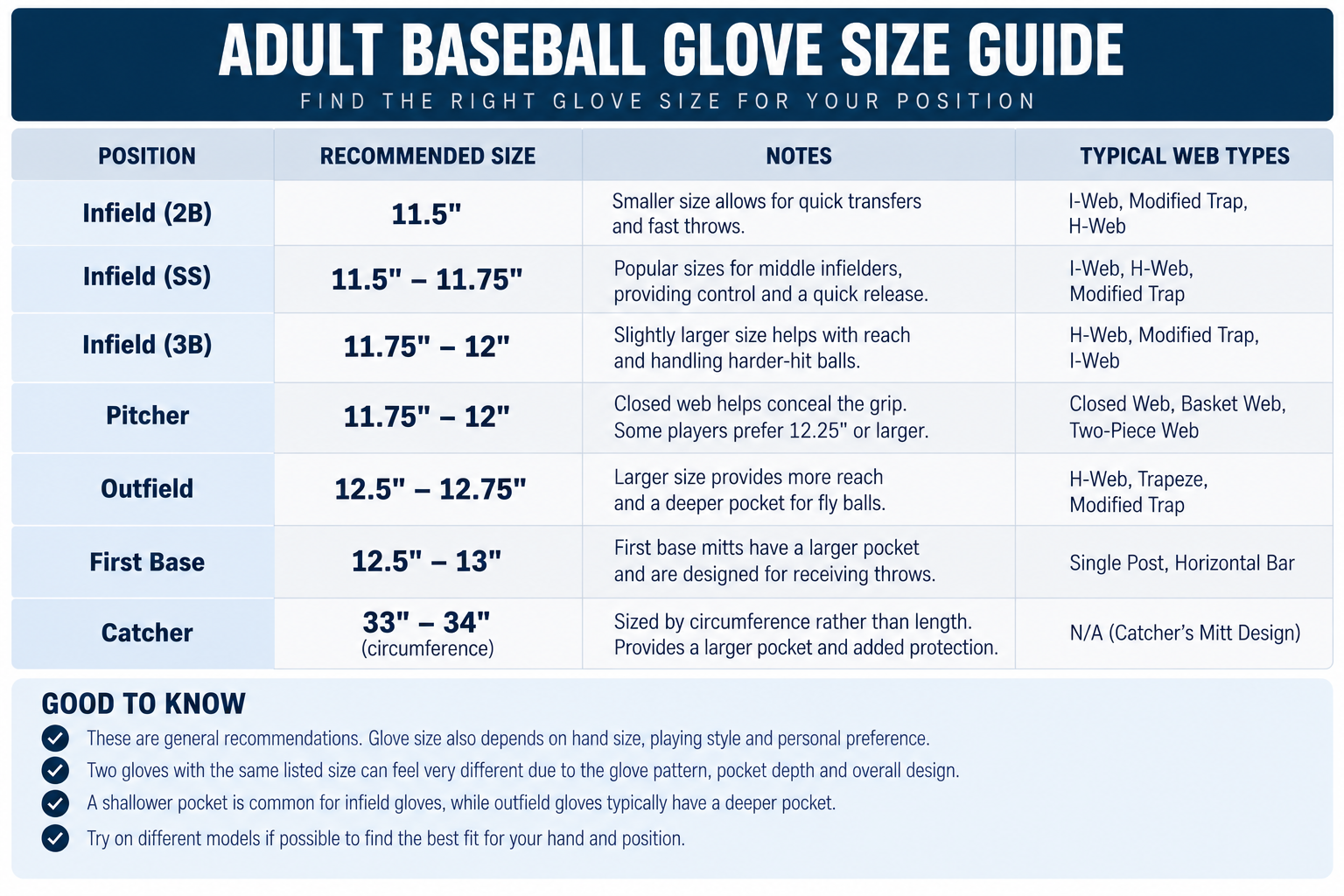
Use the table below as a general starting point when choosing your glove.
3. Youth Baseball Glove Size by Age
4. Youth vs Adult Baseball Gloves
One of the most common misconceptions is that a youth glove is simply a smaller adult glove.
There is more to it than that.
Youth baseball gloves typically have:
- smaller hand openings
- narrower finger stalls
- shorter finger stalls
- lighter construction
- softer materials
- easier glove closure
This allows young players with smaller and weaker hands to control the glove properly.
For example, a 12" youth glove and a 12" adult glove may have the same measured glove length but feel completely different on the player's hand.
As young players grow and develop more hand strength, they can gradually transition to adult or intermediate-fit gloves.
5. RHT vs LHT – Which Glove Do I Need?
Always check the throwing-hand designation before ordering a baseball glove.
RHT – Right Hand Throw
RHT means the player throws with their right hand.
The glove is worn on the left hand.
If you're right-handed and throw a baseball with your right hand, choose RHT.
LHT – Left Hand Throw
LHT means the player throws with their left hand.
The glove is worn on the right hand.
If you're left-handed and throw with your left hand, choose LHT.
Remember: RHT and LHT describe your throwing hand – not the hand wearing the glove.
6. Does Hand Size Matter?
Yes. However, hand size and glove size are two different things.
A glove marked 11.5", for example, is not designed specifically for an 11.5-inch hand. The measurement refers to the size of the glove itself.
Hand size becomes particularly important when deciding between:
- Youth Fit
- Narrow Fit
- Standard Adult Fit
- other reduced wrist or hand-opening designs
Players with smaller hands may feel much more comfortable in a narrow or youth-fit glove even when using the same glove length as another player.
7. How to Measure Your Hand for a Baseball Glove
Hand measurements can help determine whether a youth, narrow or standard adult fit will be most comfortable.
Measuring Hand Length
- Open your catching hand and keep your fingers straight.
- Measure from the base of your palm to the tip of your middle finger.
- Record the measurement in centimeters or inches.
Measuring Hand Circumference
- Open your hand naturally.
- Wrap a flexible measuring tape around the widest part of your palm, just below the knuckles.
- Do not include your thumb.
- Keep the tape comfortably snug rather than tight.
These measurements can help compare different glove fits, but there is no universal hand measurement that corresponds directly to a particular baseball glove size.
Glove patterns and internal dimensions vary between manufacturers and even between different models from the same brand.
8. Understanding Baseball Glove Fit
Two gloves marked 11.5" can fit very differently.
Manufacturers use different hand openings, wrist adjustments, finger stalls and internal patterns.
Standard Fit
Designed for most adult hands and commonly found on adult baseball gloves.
Narrow Fit
A smaller hand opening and narrower finger stalls provide a more secure fit for players with smaller hands.
Youth Fit
Designed specifically for children's hands, usually combining a smaller wrist opening with shorter and narrower finger stalls.
Brand-Specific Fits
Some manufacturers use their own names for specialized fits.
For example, Wilson offers Pedroia Fit patterns designed with smaller hand openings and shorter finger stalls, making them suitable for players who prefer a more secure fit.
Always check the individual product description when glove fit is particularly important.
9. Baseball Glove Web Types
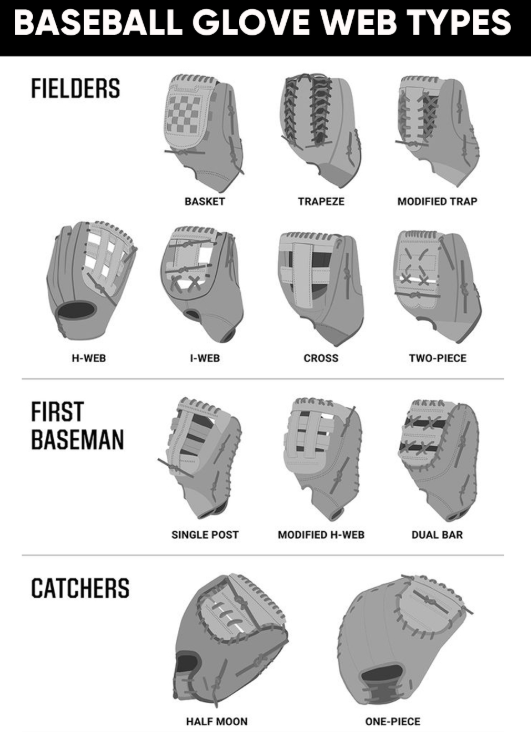
The web is the section of the glove connecting the thumb and index finger. Different web designs can influence pocket depth, visibility, structure and flexibility.
I-Web
Very popular among middle infielders.
Its relatively open design works particularly well with shallower pockets and quick ball transfers.
Best for: Second Base, Shortstop
H-Web
A versatile web commonly found on third base and outfield gloves.
It provides good structure while maintaining visibility through the glove.
Best for: Third Base, Outfield
Trapeze Web
Commonly associated with outfield gloves.
The design helps create a deep pocket and provides excellent reach when tracking fly balls.
Best for: Outfield
Modified Trap Web
A versatile design used at several positions, including infield and pitching.
Best for: Infield, Pitcher
Closed Web
Particularly popular among pitchers because it helps conceal the player's grip on the baseball.
Best for: Pitcher
There is no single "best" web. Position matters, but personal preference also plays an important role.
10. Baseball Glove Leather and Materials
The material used in a baseball glove has a major influence on its weight, durability, structure, feel and break-in time.
Synthetic Materials
Synthetic gloves are generally:
- lightweight
- affordable
- easy to close
- ready to play almost immediately
They can be a good choice for beginners and younger children.
Soft Leather
Entry-level leather gloves offer a more traditional feel while remaining relatively easy to break in.
They are a good option for recreational players and developing youth players.
Full-Grain and Premium Leather
Higher-level gloves use stronger, higher-quality leather that provides better structure and durability.
These gloves normally require more break-in but gradually form around the player's hand and playing style.
Kip Leather
Kip leather is commonly used in premium baseball gloves. It offers an excellent combination of structure, relatively low weight and a smooth feel.
Premium gloves are generally best suited to experienced players who want a glove capable of maintaining its shape through regular training and competitive play.
11. How Much Should You Spend on a Baseball Glove?
The most expensive glove isn't automatically the best choice for every player.
Beginner / Young Player
Look for:
- easy closure
- lightweight construction
- comfortable fit
- minimal break-in
A young beginner will usually benefit more from a glove they can easily control than from an extremely stiff professional-level model.
Developing / Intermediate Player
As players improve, higher-quality leather provides better structure, durability and feel.
This is often the point where investing in a better glove starts to make sense.
Competitive / Advanced Player
Experienced players often prefer premium leather gloves designed to maintain their shape through intensive training and competition.
At this level, pattern, pocket depth, fit and leather quality become increasingly important.
12. Do Baseball Gloves Need to Be Broken In?
Most high-quality leather baseball gloves require some break-in.
A new premium glove may initially feel stiff because the leather needs time to form around the player's hand and develop the desired pocket.
The safest approach is usually simple:
- play catch regularly
- work the pocket with a baseball
- flex the glove naturally
- gradually shape it to your preferred playing style
Avoid extreme methods involving excessive heat or moisture, as they can damage or dry out the leather.
Youth and entry-level gloves often arrive much softer and may require little or no break-in.
13. Baseball vs Softball Gloves
Baseball and fastpitch softball gloves may look similar, but they aren't always designed the same way.
Softball gloves need to accommodate a larger ball and therefore often feature:
- larger glove sizes
- deeper pockets
- different glove patterns
- hand openings designed specifically for fastpitch players
If you play fastpitch softball regularly, choosing a dedicated Fastpitch Softball Glove will usually provide a better combination of fit and pocket design than a comparable baseball glove.
→ SHOP FASTPITCH SOFTBALL GLOVES
Quick Baseball Glove Buying Checklist
Before ordering your glove, check:
✓ Position – Infield, Outfield, Pitcher, Catcher or First Base?
✓ Size – Is the glove size suitable for your position and age?
✓ Throwing Hand – RHT or LHT?
✓ Fit – Youth, narrow or standard adult fit?
✓ Material – Do you want an easy-to-use glove or premium leather that requires break-in?
✓ Web – Does the web style suit your position and preference?
✓ Level of Play – Beginner, developing player or competitive athlete?
Getting these seven things right will narrow your options considerably.
FAQ About Baseball Gloves
What size baseball glove should I get?
The right size depends primarily on your position, age and hand size. Adult infielders commonly use gloves between 11.5" and 12", while outfielders generally use 12.25"–12.75". Youth players may need smaller gloves or models with youth-specific hand openings.
What is the most common baseball glove size?
There is no single universal size. 11.5" is one of the most popular sizes for adult infielders, while 12.75" is extremely common among outfielders.
Is an 11.5" baseball glove too small?
Not for an infielder. An 11.5" glove is one of the most popular choices for adult infield players.
For an adult outfielder, however, it would normally be considered small.
Is a 12.75" baseball glove too big?
A 12.75" glove is very common for adult outfielders.
For most middle infielders, however, it would be unnecessarily large and could make quick ball transfers more difficult.
What size baseball glove should a child use?
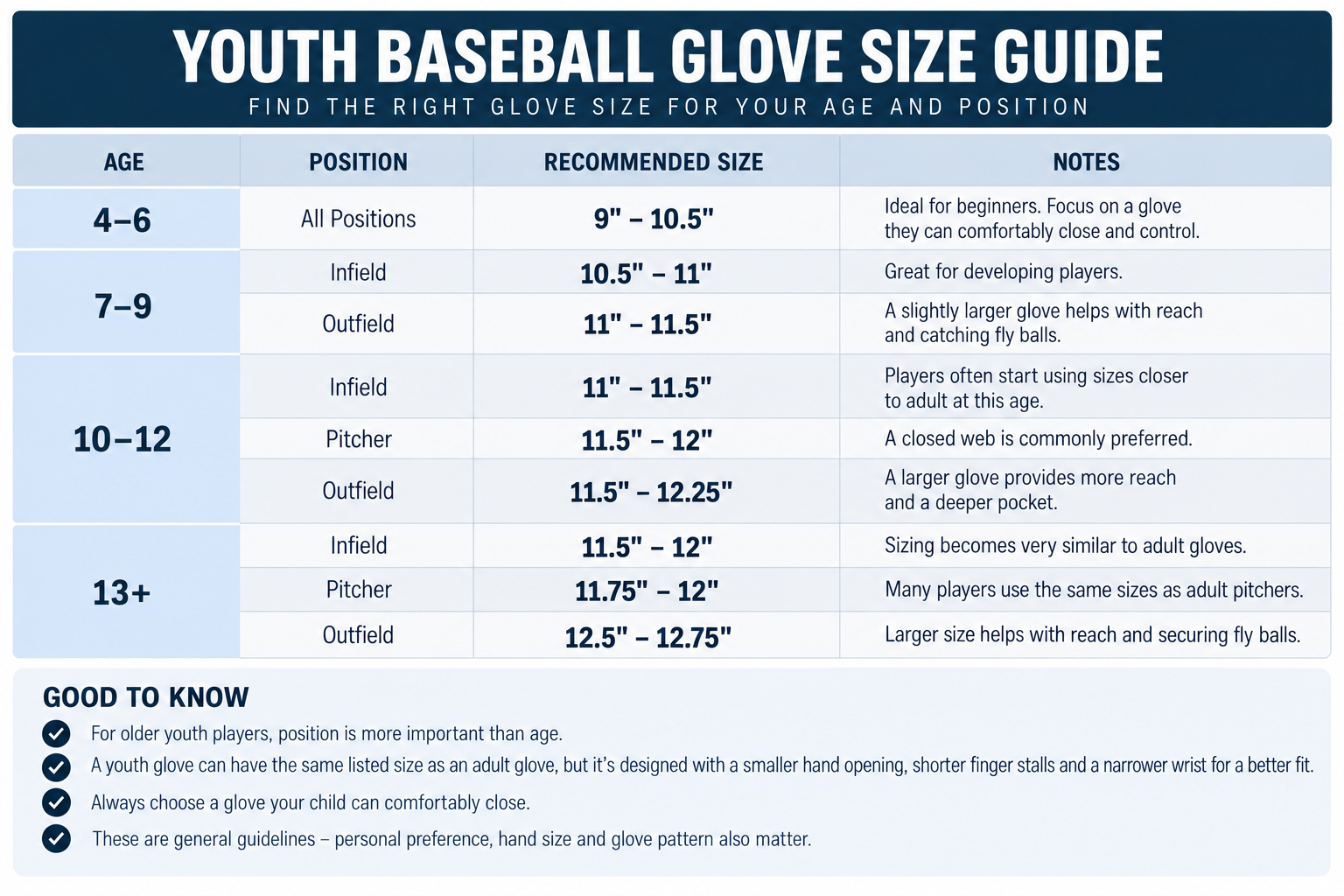
It depends on age, hand size and position. Younger children commonly use gloves between approximately 9" and 11", while older youth players may use 11"–12" or larger depending on their position.
Most importantly, the glove should fit securely and be easy enough for the child to close and control.
Should a baseball glove fit tight?
A baseball glove should feel secure without being uncomfortably tight. It shouldn't move excessively on the hand during play.
Players with smaller hands may benefit from youth or narrow-fit models.
Which hand does a baseball glove go on?
The glove goes on your non-throwing hand.
Right-handed throwers wear their glove on the left hand and need an RHT glove.
Left-handed throwers wear their glove on the right hand and need an LHT glove.
What is the difference between an infield and outfield glove?
Infield gloves are generally smaller and have shallower pockets for faster ball transfers.
Outfield gloves are larger and deeper to provide additional reach and help secure fly balls.
Can I use the same glove for every position?
For young beginners, one versatile glove can often be used across several positions.
As players become older and more specialized, position-specific gloves become more useful. Catchers and first basemen require dedicated mitts, while competitive infielders and outfielders generally benefit from gloves designed for their positions.
How long does a good baseball glove last?
A high-quality leather baseball glove can last for many seasons when properly maintained. Its lifespan depends on the quality of the leather, frequency of use, playing conditions and how well the glove is cared for.
Still Not Sure Which Baseball Glove to Choose?
Choosing between different sizes, patterns and fits can still be difficult – especially when buying your first baseball glove or choosing one for a young player.
At BaseballOutlet, we specialize in baseball and softball equipment and offer gloves for players of different ages, positions and levels of play.
If you're unsure which model to choose, contact us and tell us the player's age, position, throwing hand and approximate hand size. We'll be happy to help you find the right glove.
 Log in with Facebook
 Log in with Google